
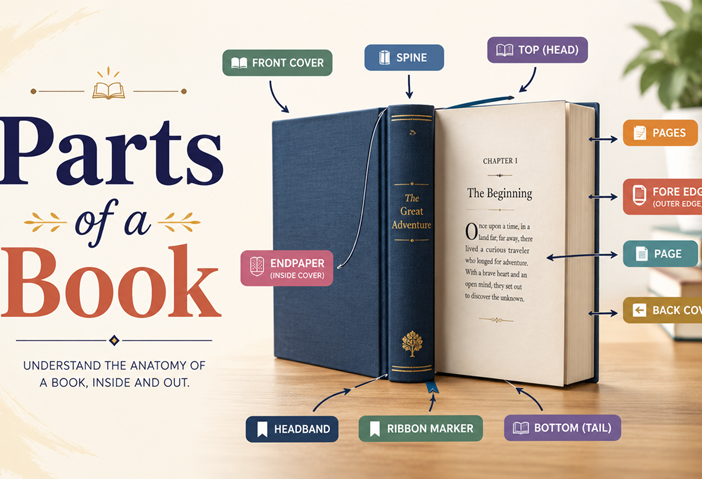
Most readers open a book and dive straight into the story, never pausing to consider the carefully arranged pages that came before the first chapter or the thoughtful sections that follow the last. For aspiring authors, this blind spot can be costly. Publishing a manuscript without understanding the full anatomy of a book is like building a house without a floor plan: the result may hold together, but it will never feel quite right to the people inside.
The good news is that once you understand the parts of a book, the entire publishing process becomes less intimidating. Whether you are a reader wanting to explore books more deeply or a writer preparing your first manuscript, this guide walks you through every section you need to know, and why each one matters more than you might think.
The Three Core Parts of a Book
Every published book, fiction or nonfiction, follows the same foundational layout: front matter, body matter, and back matter. Think of these as the lobby, the main halls, and the exit wing of a well-designed building. Each zone serves a distinct purpose, and together they create a reading experience that feels professional, complete, and trustworthy.
Front Matter: Your Book’s First Impression

The front matter is everything that appears before the story begins. Many readers skip these pages entirely, but they carry enormous weight in establishing credibility and setting the reader’s expectations.
Here are the key front matter components:
- Half Title Page – The very first interior page, containing only the book’s title.
- Title Page – Displays the full title, subtitle, author name, and publisher details.
- Copyright Page – A legally essential page that protects your intellectual property and lists the ISBN, edition, and publishing year.
- Dedication Page – A brief personal note to someone meaningful to the author, usually just a sentence or two.
- Table of Contents – Lists all chapters or sections with corresponding page numbers, especially important in nonfiction.
- Foreword – Written by someone other than the author, typically an expert or notable figure who vouches for the book’s value.
- Preface – The author’s own explanation of why the book was written and who it is for.
- Introduction – Prepares the reader for the content ahead, explaining what to expect and how to use the book.
One of the most misunderstood distinctions in publishing is the difference between a foreword and a preface. A foreword always comes from an outside voice; a preface is the author speaking directly to the reader before the story begins. Knowing this distinction makes you a sharper reader and a more polished writer.
For authors serious about book promotion, the front matter is prime real estate. It is often included in the free preview sample on Amazon and other retail platforms, which means these pages double as a sales pitch for your book.
Body Matter: The Heart of the Book

The body is where the real work lives. It is the story, the argument, the lesson, or the journey your reader committed to when they picked up the book.
Prologue
Common in fiction, a prologue drops the reader into a scene or moment that is separate from the main narrative. Stephen King used this technique brilliantly in Salem’s Lot, using a prologue to create immediate tension before the plot proper begins. A prologue should contain information that is genuinely vital to understanding the story, not just additional backstory that could have been worked into the chapters themselves.
Chapters and Parts
Chapters are the primary organizational units of any book. They break the content into digestible segments and give readers natural stopping points. Some authors group chapters into larger “parts” or “acts” to signal a major shift in theme, time period, or point of view. The number of scenes per chapter also affects pacing: shorter, more numerous scenes create momentum, while longer scenes invite reflection.
Epigraph
An epigraph is a short quote, poem, or phrase placed at the beginning of the book or at the start of individual chapters. Harper Lee opened To Kill a Mockingbird with an epigraph from Charles Lamb, immediately signaling the novel’s central concern with childhood and justice. These small touches reveal a great deal about a writer’s literary awareness.
Epilogue
Where the prologue opens before the story begins, the epilogue closes after it ends. It answers the reader’s lingering question: “What happens next?” J.K. Rowling’s epilogue in Harry Potter and the Deathly Hallows, set 17 years after the final chapter, is perhaps the most widely discussed epilogue in modern fiction. It offers resolution without diminishing the emotional weight of the ending.
Back Matter: The Often-Overlooked Goldmine

The back matter is where nonfiction books earn their long-term credibility and where fiction authors build loyalty for what comes next. It is also one of the most neglected parts of any self-published book.
Here are the most important back matter components:
- Afterword – Similar to a preface but placed at the end; the author reflects on the writing process or updates the reader on developments since the book was first written.
- Acknowledgments – A space to thank editors, agents, researchers, family, and anyone who supported the book’s creation.
- Appendix – Used in nonfiction to include supplementary data, charts, or research that would have disrupted the flow of the main text.
- Glossary – Defines specialized terms, particularly valuable in academic or technical books.
- Bibliography / References – Credits the sources used in the research, protecting the author from plagiarism and adding credibility.
- Index – An alphabetical reference tool for readers who want to locate specific topics quickly.
- Author Bio – Introduces the author to readers who finished the book and want to know more about who wrote it.
- Coming Soon / Read More Page – Especially useful for series authors, this section points readers toward the next book, building momentum between releases.
If you want to promote your book effectively, never underestimate the back matter. An author bio with a newsletter link, a coming-soon teaser, or even a curated list of your other works can turn a one-time reader into a lifelong fan. For deeper insight into how reading lists and curated recommendations influence readers, explore how other authors approach titles like books you should read before you die to see how recommendation framing builds authority.
Why Book Structure Matters for Writers
The publishing landscape has shifted significantly. Readers today consume books across print, ebook, and audiobook formats, and each format places different demands on book structure. A well-organized table of contents, for instance, is not just a nice-to-have in an ebook: it becomes a clickable navigation system that directly affects reader satisfaction and review scores.
For authors producing science fiction novels or genre fiction with expansive world-building, a well-placed map, a detailed glossary, or an author’s note can dramatically enhance the reading experience. The same applies to writers in the Christian fiction space, where a thoughtful author’s note about the spiritual themes in a book can deepen reader connection and invite meaningful conversation.
Understanding the book anatomy also helps readers become more discerning. When you know what a foreword is supposed to do, you can evaluate whether the person writing it genuinely adds credibility. When you understand that an epilogue is a deliberate structural choice, you stop seeing it as an afterthought and start appreciating the craft behind it.
FAQs: Parts of a Book Every Reader and Writer Should Know
A foreword is always written by someone other than the author, usually to lend the book outside credibility. A preface is the author’s own words, explaining their motivation and background before the story begins.
No. Epilogues are most common in fiction and are entirely optional. They work best when there is a meaningful story development that occurs after the main narrative ends and when that development genuinely satisfies the reader’s lingering questions.
Front matter refers to all the pages that appear before the main body text: the title page, copyright page, dedication, table of contents, foreword, preface, and introduction.
No. A prologue is a storytelling device used primarily in fiction. An introduction is a nonfiction element that explains what the book covers and prepares the reader for the content ahead.
Back matter typically includes the afterword, acknowledgments, appendix, glossary, bibliography, index, author bio, and promotional pages pointing readers to additional titles.
Understanding the parts of a book is not just academic knowledge. It is a practical skill that shapes how you read, how you write, and how you publish. Whether you are working toward your first manuscript or simply want to appreciate the books on your shelf more fully, knowing how each section functions transforms a book from a collection of pages into a finely engineered experience.
The next time you open a book, take a moment to read the preface, check the table of contents, and flip to the author bio at the end. You will find an entire conversation happening around the story, one that most readers never notice but always feel.
Leave a Reply
You must be logged in to post a comment.